Managing business finances becomes more challenging as your company grows. From recording daily transactions to reconciling bank accounts and preparing financial reports, bookkeeping requires time, attention, and accounting knowledge.
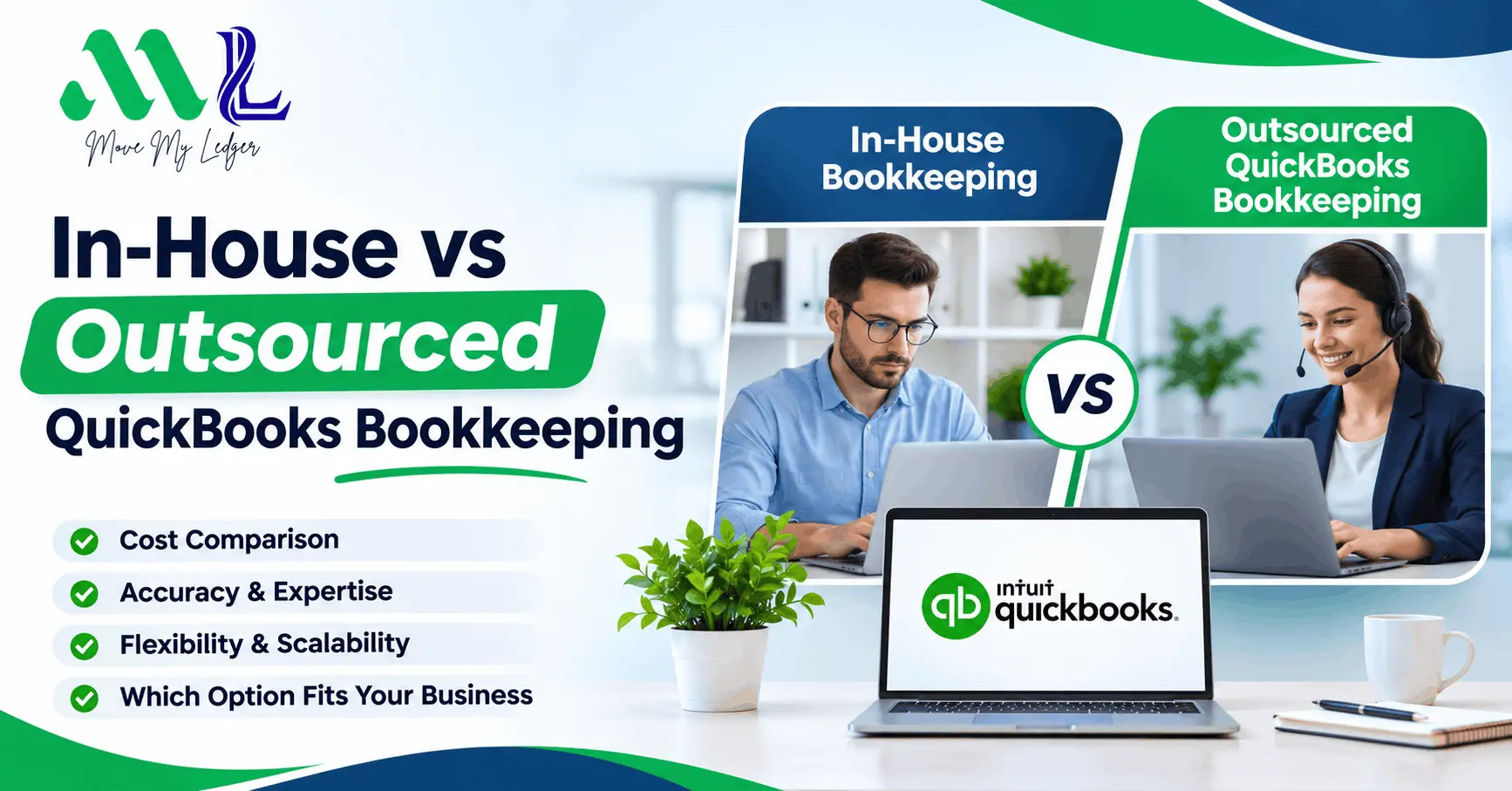
Many business owners face an important decision: should they hire an internal bookkeeper or choose outsourced QuickBooks bookkeeping?
Both options offer advantages. An internal bookkeeper provides direct access and greater daily involvement, while outsourcing offers professional expertise, flexible support, and potentially lower operating costs.
For small and medium sized businesses across the USA and Canada, choosing the right bookkeeping model can improve financial visibility, reduce administrative work, and support long term growth.
In this guide, we compare both approaches based on cost, accuracy, flexibility, security, and business requirements to help you make an informed decision.
What Is In-House QuickBooks Bookkeeping?
In-house QuickBooks bookkeeping involves hiring an employee or building an internal finance team to manage your business accounts using QuickBooks.
The bookkeeper works directly for your company and manages financial records according to your business requirements.
Typical responsibilities include:
- Recording sales and purchase transactions.
- Managing customer invoices.
- Recording business expenses.
- Reconciling bank and credit card accounts.
- Tracking outstanding customer payments.
- Monitoring supplier bills.
- Preparing monthly financial reports.
- Maintaining accurate financial records.
- Supporting tax preparation.
An internal bookkeeper may work from your office or remotely as a member of your team.
This approach can be suitable for businesses that require regular financial support, immediate communication, and close coordination between departments.
However, maintaining an internal bookkeeping team also introduces employment costs, training requirements, and management responsibilities.
What Is Outsourced QuickBooks Bookkeeping?
Outsourced QuickBooks bookkeeping involves hiring an external bookkeeping professional or accounting service provider to manage your financial records.
Instead of employing a permanent bookkeeper, your business pays for an agreed level of bookkeeping support.
With QuickBooks Online, external bookkeepers can access your accounting records remotely through authorized user access. Business owners can continue to monitor their accounts, review reports, and manage financial decisions.
Outsourced bookkeeping services may include:
- Daily or monthly transaction recording.
- Bank and credit card reconciliation.
- Expense categorization.
- Invoice management.
- Accounts payable and receivable tracking.
- Monthly financial reporting.
- Cash flow monitoring.
- Sales tax tracking.
- Bookkeeping cleanup and catch up support.
- QuickBooks account maintenance.
The exact services depend on the agreed bookkeeping package.
According to Intuit’s guide to outsourcing bookkeeping, businesses can benefit from external expertise, flexible support, and reduced staffing responsibilities by outsourcing their bookkeeping.
In-House vs Outsourced QuickBooks Bookkeeping: Key Differences
Understanding the differences between these two approaches can help you select the right option for your business.
| Comparison Factor | In-House Bookkeeping | Outsourced Bookkeeping |
|---|---|---|
| Employment Costs | Salary, benefits, and employment expenses | Agreed service fee |
| QuickBooks Expertise | Depends on employee qualifications | Access to specialist expertise |
| Scalability | May require additional recruitment | Support can be adjusted |
| Training | Managed by the business | Typically managed by the provider |
| Availability | Based on employee working hours | Based on service agreement |
| Financial Control | Direct internal supervision | Shared access and agreed controls |
| Staff Absence | May interrupt bookkeeping | Team coverage may be available |
| Technology | Managed internally | Provider may introduce additional tools |
| Reporting | Based on internal processes | Based on agreed reporting schedules |
| Recruitment | Required when hiring employees | No direct employee recruitment |
| Business Knowledge | Often strong internal familiarity | Requires effective onboarding |
| Management Responsibility | Higher internal responsibility | Reduced staff management |
Neither model is automatically better for every business. The right choice depends on your financial complexity, budget, transaction volume, and operational needs.
1. Cost of In-House vs Outsourced QuickBooks Bookkeeping
Cost is one of the biggest factors when choosing a bookkeeping model.
In-House Bookkeeping Costs
Hiring a bookkeeper involves more than paying a monthly salary.
Additional expenses may include employee benefits, recruitment fees, payroll taxes, training, office equipment, paid leave, and software subscriptions.
Businesses must also consider the cost of replacing employees when they leave or providing temporary cover during absences.
These expenses can make internal bookkeeping more expensive than expected, particularly for businesses that do not require full time financial support.
Outsourced Bookkeeping Costs
Outsourced QuickBooks bookkeeping typically follows a monthly, hourly, or customized pricing model.
Your bookkeeping fees may depend on:
- Monthly transaction volume.
- Number of bank accounts.
- Business size and complexity.
- Reporting requirements.
- Number of business entities.
- Additional bookkeeping responsibilities.
Businesses can select a service package that matches their requirements rather than paying for a full time employee.
However, outsourcing is not always cheaper. Businesses with complex operations and extensive daily bookkeeping needs should compare the total cost of both approaches before making a decision.
2. Financial Accuracy and QuickBooks Expertise
Accurate bookkeeping is essential for understanding profitability, monitoring expenses, and preparing reliable financial reports.
Even small bookkeeping errors can create problems when they remain unnoticed for several months.
In-House Bookkeeping
The quality of internal bookkeeping depends heavily on the employee’s knowledge and experience.
A qualified employee who understands your business and QuickBooks can provide excellent financial support.
However, relying on a single individual may create difficulties when complex accounting issues arise or an independent review is needed.
Businesses may need to invest in ongoing training to maintain professional standards.
Outsourced Bookkeeping
A professional outsourced bookkeeping provider can offer access to experienced QuickBooks specialists and additional review processes.
These professionals can help identify:
- Duplicate transactions.
- Incorrect expense categories.
- Missing invoices.
- Unreconciled bank transactions.
- Incorrect opening balances.
- Inconsistent financial records.
- Reporting discrepancies.
Through our QuickBooks bookkeeping services, Move My Ledger helps businesses maintain organized financial records, complete account reconciliations, and prepare useful monthly reports.
Professional support can reduce the risk of bookkeeping mistakes, although regular reviews remain important under either model.
3. Time Management and Business Productivity
Business owners have limited time.
Managing customers, employees, marketing, sales, and daily operations already requires significant attention.
Adding bookkeeping responsibilities can create unnecessary pressure, especially when financial records fall behind.
In-house bookkeeping reduces the amount of financial administration handled directly by business owners. However, owners may still need to supervise employees, review their work, and organize training.
Outsourcing can reduce these management responsibilities.
With a clearly defined service agreement, business owners can spend less time coordinating routine bookkeeping tasks and more time focusing on:
- Increasing sales.
- Improving customer satisfaction.
- Developing new products.
- Expanding into new markets.
- Building business partnerships.
- Planning future investments.
The time saved can be particularly valuable for startups and small businesses without dedicated finance managers.
4. Scalability and Business Growth
Bookkeeping requirements rarely remain the same as a business grows.
A company processing a small number of transactions today may handle thousands of transactions in the future.
Growth can introduce new bank accounts, employees, payment platforms, sales channels, and reporting requirements.
Scaling an Internal Bookkeeping Team
An internal bookkeeping team may require additional employees as workloads increase.
Recruitment, training, and supervision take time. During busy periods, existing employees may struggle to complete all bookkeeping tasks on schedule.
Scaling an Outsourced Bookkeeping Service
One of the main advantages of outsourced QuickBooks bookkeeping is the ability to adjust support as business requirements change.
For example, a growing ecommerce business may require additional help with marketplace settlements, payment processing fees, refunds, and inventory records.
An experienced provider may be able to expand its services without requiring the business to recruit additional employees.
This flexibility can support business growth while keeping financial responsibilities manageable.
5. Financial Data Security and Access Control
Financial information contains sensitive business details, including bank transactions, customer information, supplier records, and revenue figures.
Protecting this information should be a priority regardless of which bookkeeping model you choose.
Internal bookkeeping allows businesses to supervise employees directly. However, internal access does not automatically eliminate the risk of mistakes, unauthorized activity, or data loss.
External bookkeeping requires careful provider selection and clearly defined security procedures.
Businesses using QuickBooks Online should follow good security practices, including:
- Using individual user accounts.
- Enabling multifactor authentication.
- Assigning appropriate access permissions.
- Reviewing account activity.
- Removing unnecessary user access.
- Avoiding shared passwords.
- Maintaining appropriate financial records and backups.
- Separating payment approval from bookkeeping responsibilities.
QuickBooks Online offers different user roles and permissions, although available options vary by subscription and region.
Business owners should retain administrative control over their accounting software and approve important financial decisions.
6. Financial Reporting and Business Insights
Bookkeeping is not simply about recording transactions.
Its greater value comes from helping business owners understand financial performance.
Accurate financial reports can reveal whether a business is profitable, where expenses are increasing, and whether customers are paying on time.
Both internal and external bookkeepers can prepare important financial reports, including:
Profit and Loss Statement
Shows business income, expenses, and profit or loss over a specific period.
Balance Sheet
Provides an overview of business assets, liabilities, and equity at a specific date.
Cash Flow Reports
Help business owners understand how money moves into and out of the business.
Accounts Receivable Aging Report
Identifies outstanding customer invoices and overdue payments.
Accounts Payable Aging Report
Shows unpaid supplier bills and outstanding payment obligations.
A professional bookkeeping service can help establish regular reporting schedules so that business owners have access to timely financial information.
The effectiveness of these reports depends on accurate source data, completed reconciliations, and consistent bookkeeping procedures.
7. Business Continuity and Staff Availability
Relying on one internal bookkeeper can create operational risks.
When an employee takes annual leave, becomes ill, or resigns, essential bookkeeping tasks may be delayed.
This can result in incomplete reconciliations, outdated reports, and difficulties preparing financial information for accountants.
A bookkeeping provider with multiple trained professionals may offer better continuity by arranging cover when a team member becomes unavailable.
However, not every outsourcing provider offers the same level of support.
Before signing an agreement, businesses should confirm how the provider manages staff absences, urgent requests, and reporting deadlines.
Advantages and Disadvantages of In-House QuickBooks Bookkeeping
Advantages
- Direct communication with your bookkeeper.
- Strong understanding of internal business operations.
- Immediate support during agreed working hours.
- Greater involvement in daily financial activities.
- Easier coordination with internal departments.
- Customized working processes.
Disadvantages
- Higher potential employment costs.
- Ongoing recruitment and training requirements.
- Additional employee management responsibilities.
- Dependence on individual employee availability.
- Difficulty increasing or reducing staffing quickly.
- Limited specialist knowledge in some cases.
Internal bookkeeping can be an effective choice for businesses that require continuous financial administration and have sufficient resources to maintain an experienced team.
Advantages and Disadvantages of Outsourced QuickBooks Bookkeeping
Advantages
- Access to experienced QuickBooks professionals.
- Flexible bookkeeping support.
- Reduced recruitment responsibilities.
- Potentially lower operating costs.
- More time for core business activities.
- Structured financial reporting.
- Support that can adapt to business growth.
Disadvantages
- Less direct involvement in daily bookkeeping activities.
- Dependence on external service availability.
- Possible communication delays.
- Requirement to share financial information securely.
- Additional charges for work outside the agreed scope.
- Initial time needed to understand business operations.
Choosing a reliable provider with clear communication, appropriate security procedures, and transparent pricing can help address many of these challenges.
Which Businesses Benefit Most from Outsourced QuickBooks Bookkeeping?
Although outsourcing can support many types of organizations, certain businesses may find it particularly beneficial.
Small Businesses
Small businesses often need professional financial support but may not have enough bookkeeping work to justify a full time employee.
Outsourcing allows them to access bookkeeping expertise based on their actual requirements.
Startups
Startups need accurate financial records to monitor spending, manage available cash, and prepare for investment discussions.
External bookkeeping support can help establish consistent accounting processes from the beginning.
Ecommerce Businesses
Online sellers often manage transactions across Shopify, Amazon, WooCommerce, Stripe, PayPal, and other platforms.
Professional bookkeeping support can help reconcile marketplace settlements, record processing fees, and track refunds accurately.
Professional Service Businesses
Consultants, marketing agencies, legal practices, and other service businesses need accurate income and expense records to understand profitability.
Outsourcing routine bookkeeping allows these businesses to concentrate on delivering client services.
Growing Businesses
Businesses experiencing rapid growth may struggle to maintain accurate financial records with their existing resources.
External bookkeeping support can help manage increasing transaction volumes and changing reporting requirements.
Businesses With Outdated Financial Records
Businesses that have fallen behind on their bookkeeping may need specialist assistance to correct historical transactions before establishing regular monthly bookkeeping.
An experienced provider can assess the existing records and recommend appropriate cleanup and ongoing support.
When Should You Keep QuickBooks Bookkeeping In-House?
Despite the benefits of outsourcing, internal bookkeeping may be the better choice in certain situations.
Consider maintaining an internal bookkeeping team when your business:
- Requires continuous daily financial administration.
- Handles large volumes of time sensitive transactions.
- Needs regular physical document processing.
- Requires immediate coordination between multiple departments.
- Maintains complex internal approval procedures.
- Has sufficient resources to employ qualified financial professionals.
Larger businesses with complex operations may benefit from having internal staff available throughout the working day.
However, even these businesses can use external specialists for specific accounting tasks, additional reviews, and temporary workload support.
Can You Combine In-House and Outsourced Bookkeeping?
Businesses do not necessarily need to choose one approach exclusively.
A combined bookkeeping model allows internal employees and external specialists to share responsibilities.
For example:
| Internal Team Responsibilities | External Bookkeeper Responsibilities |
|---|---|
| Collect receipts and documents | Review and categorize transactions |
| Approve supplier payments | Reconcile bank accounts |
| Communicate with customers | Review outstanding invoices |
| Manage daily operations | Prepare monthly financial reports |
| Approve financial decisions | Identify bookkeeping discrepancies |
| Provide business information | Maintain organized accounting records |
This approach allows businesses to retain control over important financial decisions while accessing external expertise.
It can be particularly useful for growing organizations that have administrative employees but do not require a complete internal accounting department.
How to Choose the Right QuickBooks Bookkeeping Provider
Selecting the right bookkeeping partner is an important business decision.
Before hiring an external provider, consider the following factors.
QuickBooks Qualifications
Check whether the provider has relevant QuickBooks certifications and practical bookkeeping experience.
Industry Experience
Choose a provider that understands your business model, transaction types, and reporting requirements.
Transparent Pricing
Request a clear explanation of monthly fees, included services, and potential additional charges.
Communication and Availability
Confirm how frequently you will receive updates, who will manage your account, and how urgent questions will be handled.
Financial Data Security
Ask how the provider manages confidential information, access permissions, document sharing, and data protection.
Quality Control
Understand how transactions, reconciliations, and financial reports are reviewed before completion.
Reporting Schedule
Agree on monthly reporting deadlines and the financial reports your business requires.
Tax and Accounting Support
Confirm whether the provider offers bookkeeping only or additional accounting services.
Bookkeeping does not automatically include tax return preparation or filing. Businesses in the USA and Canada should continue working with appropriately qualified tax professionals when required.
How to Switch from In-House to Outsourced QuickBooks Bookkeeping
Moving to an external bookkeeping service requires proper planning to avoid interruptions.
Step 1: Review Your Existing Books
Assess your current financial records, outstanding transactions, and bookkeeping procedures.
Step 2: Define Responsibilities
Identify which bookkeeping activities will remain internal and which will be managed by the external provider.
Step 3: Provide Secure QuickBooks Access
Invite the bookkeeping provider using appropriate user permissions rather than sharing login credentials.
Step 4: Share Relevant Financial Information
Provide bank statements, invoices, supplier records, and existing accounting procedures as required.
Step 5: Complete Initial Account Reviews
Review account balances, outstanding invoices, unpaid bills, and existing reconciliations.
Step 6: Establish a Reporting Schedule
Agree on bookkeeping deadlines, communication procedures, and monthly reporting requirements.
Step 7: Monitor Performance
Regularly review reports and discuss any issues with your bookkeeping provider.
A structured transition helps maintain reliable financial records and reduces disruption to daily business activities.
Why Choose Move My Ledger for QuickBooks Bookkeeping?
At Move My Ledger, we understand that business owners need accurate financial records without unnecessary administrative responsibilities.
Our bookkeeping team supports small businesses, startups, ecommerce companies, and growing organizations across the USA and Canada.
Our QuickBooks bookkeeping support includes:
- Bank and credit card reconciliation.
- Transaction recording and review.
- Income and expense tracking.
- Customer invoice management.
- Accounts payable and receivable monitoring.
- Monthly financial reporting.
- Cash flow monitoring.
- QuickBooks account organization.
- Dedicated bookkeeping support.
We work with businesses to understand their financial requirements and establish a bookkeeping process that matches their operations.
Whether you need regular monthly bookkeeping or additional support for a growing business, our team can help you maintain reliable financial information.
Conclusion
Choosing between in-house and outsourced QuickBooks bookkeeping depends on your business size, budget, transaction volume, and financial management requirements.
Internal bookkeeping offers direct supervision and greater involvement in daily operations. Outsourcing provides access to professional expertise, flexible support, and fewer employee management responsibilities.
For many small and growing businesses, external bookkeeping can be a practical way to maintain accurate financial records without building a full internal finance department.
Ultimately, the best bookkeeping model is one that delivers reliable financial information, supports business growth, and provides the right balance between cost and control.
Take Control of Your QuickBooks Bookkeeping with Move My Ledger
Stop spending valuable business hours correcting transactions, managing reconciliations, and chasing missing financial records.
Move My Ledger provides professional outsourced QuickBooks bookkeeping services designed to help businesses maintain accurate accounts, understand financial performance, and focus on growth.
Whether you are replacing an internal bookkeeper or looking for additional financial support, our team is ready to help.