Running a business involves more than attracting customers and making sales. You also need to track expenses, manage invoices, monitor cash flow, and keep accurate financial records. While these tasks may seem manageable at first, bookkeeping often becomes more demanding as your business grows.
Xero makes accounting easier by offering cloud-based tools for invoicing, bank reconciliation, expense tracking, and financial reporting. However, using accounting software does not automatically mean your financial records will be accurate.
A small mistake in transaction categorisation, bank reconciliation, or tax treatment can affect your financial reports and business decisions.
This is why many business owners choose to hire a Xero bookkeeper rather than manage everything themselves.
A professional Xero bookkeeper can help maintain accurate records, identify potential errors, and provide reliable financial information. More importantly, professional bookkeeping support allows business owners to spend less time managing accounts and more time developing their businesses.
In this guide, we explore the differences between DIY bookkeeping and professional Xero bookkeeping, the benefits of hiring an expert, and how to decide which approach is right for your business.
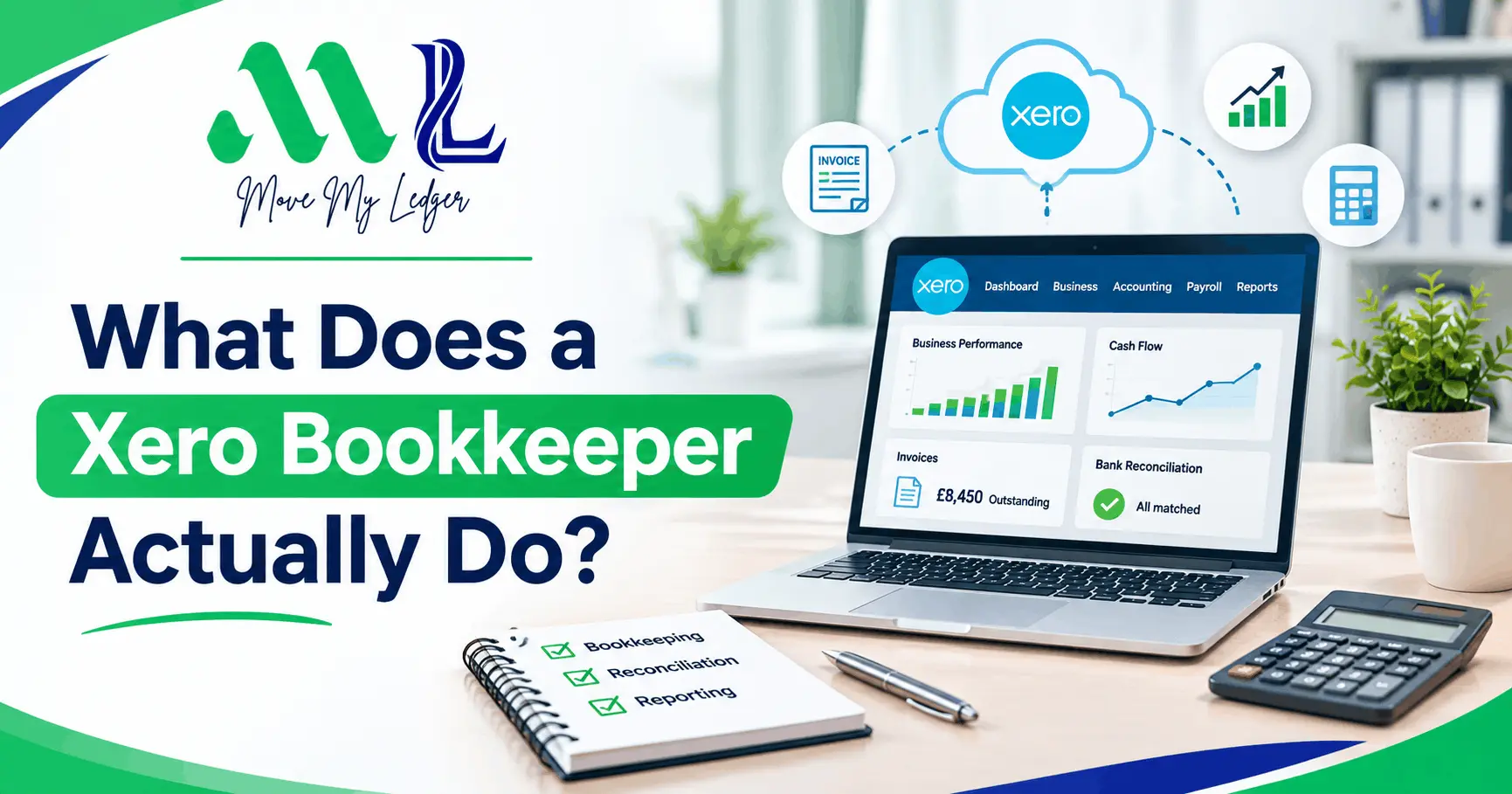
What Does a Xero Bookkeeper Do?
A Xero bookkeeper is a financial professional who uses Xero accounting software to organise, record, and maintain a business’s financial transactions.
Their primary responsibility is to ensure that financial records are accurate, complete, and regularly updated.
Unlike basic data entry, professional bookkeeping involves understanding how transactions affect business finances and ensuring that records reflect actual business activity.
Common Responsibilities of a Xero Bookkeeper
A professional Xero bookkeeper typically handles the following activities:
- Bank reconciliation: Matching bank transactions with records in Xero and investigating differences.
- Invoice management: Recording customer invoices and monitoring outstanding payments.
- Expense tracking: Categorising business expenses correctly.
- Accounts payable: Keeping track of supplier bills and payment obligations.
- Accounts receivable: Monitoring customer balances and overdue invoices.
- Financial reporting: Preparing regular profit and loss statements, balance sheets, and other financial reports.
- Tax record preparation: Maintaining organised transaction records and supporting the accountant responsible for tax compliance.
- Bookkeeping corrections: Identifying duplicate entries, missing transactions, and incorrect balances.
The exact responsibilities depend on the business’s requirements and the agreed service package.
Businesses looking for professional support can explore Move My Ledger’s Xero Bookkeeping Services to understand how ongoing financial record management works.
DIY Xero Bookkeeping: Is It Really That Simple?
Xero is designed to help business owners manage everyday accounting tasks without needing extensive accounting knowledge.
Its features can reduce manual work and make financial information easier to access.
For example, business owners can use Xero to create invoices, import bank transactions, record expenses, and generate financial reports.
However, accounting software still depends on correct information and appropriate decisions from the person using it.
Why Business Owners Choose DIY Bookkeeping
Many small business owners initially manage their own bookkeeping for several reasons.
Lower immediate costs: DIY bookkeeping avoids the additional fee of hiring an external bookkeeper.
Direct control: Business owners can enter transactions and review their financial records whenever necessary.
Simple financial activity: Businesses with relatively few transactions may find routine bookkeeping manageable.
Access to automation: Xero offers tools that help reduce repetitive tasks.
For a freelancer with a small number of monthly invoices and expenses, DIY bookkeeping may be a practical option.
However, the situation can change as transaction volumes increase.
The Hidden Challenges of DIY Bookkeeping
Many bookkeeping problems develop gradually.
An incorrectly categorised transaction may go unnoticed for several months. Duplicate expenses can affect reported profits. Unreconciled bank transactions may create differences between actual bank balances and accounting records.
These issues become more difficult to investigate when financial records are not reviewed regularly.
Business owners may also struggle with technical accounting situations, including customer deposits, payment processor fees, refunds, loans, and transactions involving multiple currencies.
Xero can record these activities, but users still need to understand their correct accounting treatment.
As a result, DIY bookkeeping can become time-consuming and potentially expensive when mistakes require professional correction.
10 Reasons to Hire a Xero Bookkeeper Instead of Doing It Yourself
The decision to hire a Xero bookkeeper is not simply about outsourcing financial administration. It is about maintaining reliable records and supporting better business decisions.
Here are ten important benefits.
1. Save Valuable Time
Time is one of the most important resources for any business owner.
Managing invoices, categorising expenses, matching bank transactions, and reviewing reports can take several hours every week.
For businesses with numerous transactions, these tasks may require even more attention.
When you hire a Xero bookkeeper, routine financial activities can be handled by someone with the appropriate experience.
This gives business owners more time to focus on customers, operations, and business development.
For example, a small ecommerce business may process hundreds of customer orders, refunds, and payment fees each month. Reviewing those transactions individually can become a substantial administrative responsibility.
A bookkeeper familiar with Xero and ecommerce accounting can help organise this information and investigate differences.
Although bookkeeping still requires business owner input, professional support can reduce the time spent on everyday financial administration.
2. Reduce Bookkeeping Errors
Accurate bookkeeping is essential for trustworthy financial reports.
Even a small accounting mistake can affect the financial information used to make business decisions.
Common bookkeeping errors include:
- Recording the same transaction twice.
- Selecting the wrong expense category.
- Missing supplier invoices.
- Incorrectly recording customer payments.
- Applying inappropriate tax codes.
- Failing to reconcile bank accounts.
- Recording transfers between bank accounts as income or expenses.
A professional Xero bookkeeper understands how to review transactions and identify potential inconsistencies.
They can also establish regular checks to reduce the likelihood of errors continuing unnoticed.
No bookkeeper can guarantee that every mistake will be prevented. However, professional review and consistent bookkeeping procedures can significantly improve record reliability.
3. Maintain Accurate Bank Reconciliations
Bank reconciliation is one of the most important parts of bookkeeping.
It involves comparing bank statement transactions against the corresponding transactions recorded in the accounting system.
Xero includes features that support transaction matching and reconciliation.
However, automated suggestions still require appropriate review.
For example, Xero may suggest a match for an imported bank transaction, but the user must confirm that the transaction relates to the correct invoice, bill, or accounting entry.
A professional bookkeeper can investigate unmatched payments, incorrect transfers, duplicates, and missing transactions.
Regular reconciliation helps businesses understand whether the cash balances recorded in Xero agree with their actual bank records.
According to Xero’s official guidance on accounting and bookkeeping, bank reconciliation is an important feature for keeping financial records current and checking that bank transactions are correctly recorded. Xero UK+1
4. Improve Financial Visibility
Business owners need accurate financial information to make informed decisions.
Without reliable bookkeeping, it can be difficult to understand whether a business is profitable, how much customers owe, or which expenses are increasing.
A Xero bookkeeper can help maintain the underlying records needed for useful financial reports.
These may include:
Profit and Loss Statement
Shows income, expenses, and profit or loss over a particular period.
Balance Sheet
Summarises assets, liabilities, and equity at a specific date.
Accounts Receivable Report
Identifies outstanding customer invoices and overdue balances.
Accounts Payable Report
Shows unpaid supplier bills and upcoming obligations.
Cash Flow Information
Helps businesses understand incoming and outgoing funds.
Financial reports become more valuable when the transactions behind them are accurate.
By maintaining current bookkeeping records, a professional can help business owners review their financial position with greater confidence.
5. Support Tax Preparation and Compliance
Tax requirements can become complicated when a business handles different types of income, expenses, and transactions.
Depending on the country and business structure, companies may need to consider VAT, GST, sales tax, income tax, or corporation tax obligations.
A Xero bookkeeper can support tax preparation by maintaining accurate financial records and applying appropriate transaction categories within their competence.
This may include organising receipts, recording taxable transactions, and identifying information that needs to be reviewed by a qualified accountant or tax professional.
For example, incorrectly categorised purchases may affect the information used to prepare a VAT return.
A professional bookkeeper can help identify such issues before records are passed to the accountant.
However, bookkeeping and tax advisory services are not identical. Specialist tax advice and certain filing responsibilities may require an appropriately qualified or authorised professional.
Hiring a bookkeeper does not remove the business owner’s legal responsibilities, but it can make tax preparation more organised.
6. Manage Growing Transaction Volumes
Bookkeeping often becomes more complicated as a business expands.
A business that originally processed twenty transactions per month might eventually handle hundreds or thousands.
Growth can introduce additional activities, such as:
- Multiple business bank accounts.
- More customers and suppliers.
- Increased invoice volumes.
- Employee expenses.
- Online payment platforms.
- International transactions.
- Different sales channels.
- More detailed financial reporting requirements.
Managing this information manually can become increasingly difficult.
A professional Xero bookkeeper can help develop consistent procedures for recording and reviewing financial activity.
They can also assess how Xero features and suitable connected applications can support the business.
This is particularly useful for ecommerce businesses, service providers, and growing companies that need dependable monthly accounting records.
7. Improve Cash Flow Monitoring
Profit and cash flow are not the same.
A business may report a profit while experiencing cash shortages because customers have not paid their invoices.
Similarly, a company may have substantial funds in its bank account while facing significant unpaid bills.
Good bookkeeping helps business owners understand these differences.
A Xero bookkeeper can monitor customer receivables, supplier balances, and transaction records to provide a clearer view of cash movements.
For example, if several customers regularly pay late, the bookkeeper can identify outstanding invoices and highlight them to the business owner.
This allows management to consider appropriate collection procedures and payment planning.
While a bookkeeper cannot guarantee stronger cash flow, accurate records provide a better foundation for cash management.
8. Identify Problems Before They Grow
Bookkeeping errors are often easier to correct when discovered early.
An incorrectly recorded transaction from last week may be straightforward to investigate.
The same problem can become more difficult after several months, particularly if supporting documents are missing.
Professional Xero bookkeeping generally involves regular reviews rather than waiting until the financial year ends.
During these reviews, a bookkeeper may identify:
- Unreconciled transactions.
- Old unpaid invoices.
- Duplicate supplier bills.
- Unexpected account balances.
- Missing expense records.
- Incorrectly classified payments.
- Transactions requiring further explanation.
Identifying these issues earlier can reduce the amount of corrective work needed later.
It can also help businesses avoid relying on financial reports that contain unresolved differences.
9. Access Specialist Xero Knowledge
Xero offers many features beyond basic invoicing and expense tracking.
Depending on the business’s subscription and configuration, these may include tracking categories, bank rules, reporting tools, multicurrency transactions, and connections with other applications.
Understanding which features are appropriate for a business requires experience.
A professional Xero bookkeeper can help configure suitable bookkeeping procedures and explain how different features should be used.
For example, a business operating across several departments may benefit from tracking categories to separate financial activity.
Another company may need more detailed reporting for different locations or projects.
Choosing an appropriate setup from the beginning can make future bookkeeping and reporting more manageable.
10. Support Long-Term Business Growth
As a company grows, financial information becomes increasingly important.
Business owners may need accurate records when applying for funding, reviewing profitability, planning investments, or preparing for expansion.
Potential lenders and investors may request financial statements and other supporting information.
When accounting records are incomplete, preparing these documents can require additional work.
A professional Xero bookkeeper can help maintain organised financial records throughout the year.
This supports accountants, financial managers, and business owners when preparing reports for important decisions.
Reliable bookkeeping is not a substitute for financial planning, but it provides essential information for that planning.
DIY Bookkeeping vs Hiring a Xero Bookkeeper
Understanding the practical differences between the two approaches can help business owners make the right decision.
| Factor | DIY Xero Bookkeeping | Professional Xero Bookkeeper |
|---|---|---|
| Cost | No separate bookkeeping fee, but requires owner time | Professional service fees |
| Time commitment | Owner handles routine bookkeeping | Routine tasks handled by a specialist |
| Accuracy | Depends on the owner’s knowledge and checks | Benefits from specialist knowledge and review |
| Bank reconciliation | Owner matches and investigates transactions | Bookkeeper manages agreed reconciliation tasks |
| Financial reporting | Owner prepares and interprets reports | Bookkeeper helps maintain and explain reports |
| Tax preparation | Owner organises financial records | Bookkeeper supports preparation and accountant collaboration |
| Complex transactions | May require additional research or outside help | More experience with accounting situations |
| Scalability | Can become difficult with growing activity | Service scope can expand with business needs |
Neither approach is automatically the best choice for every business.
The right decision depends on transaction volume, business complexity, available time, and the owner’s accounting knowledge.
When Should You Hire a Xero Bookkeeper?
Many businesses begin with DIY bookkeeping and seek professional support once their accounting requirements become more demanding.
However, waiting until serious errors appear is not always the most practical approach.
Several warning signs suggest that professional bookkeeping support may be beneficial.
Your Bookkeeping Is Regularly Behind
If transactions remain unrecorded for weeks or months, financial reports may not reflect the current position of the business.
A bookkeeper can help establish a regular recording and review schedule.
Your Bank Accounts Do Not Reconcile
Unexplained differences between bank statements and Xero balances may indicate missing, duplicated, or incorrectly recorded transactions.
A professional review can help identify the cause.
You Spend Too Much Time Managing Accounts
If bookkeeping regularly takes time away from customers or essential business activities, outsourcing may provide better value.
Your Business Has Become More Complex
Multiple sales channels, payment systems, currencies, or business entities can introduce bookkeeping challenges that require additional knowledge.
Your Accountant Frequently Finds Errors
Repeated year-end corrections may indicate that existing bookkeeping procedures need improvement.
A professional bookkeeper can help address recurring issues before the next reporting period.
You Cannot Rely on Your Financial Reports
If you regularly question whether your profit figures, customer balances, or expense totals are correct, reviewing the underlying bookkeeping should become a priority.
How Much Does It Cost to Hire a Xero Bookkeeper?
The cost of professional Xero bookkeeping varies according to the business’s requirements.
Some bookkeepers charge hourly rates, while others offer fixed monthly packages.
There is no universal price that applies to every business.
Several factors influence the cost.
Monthly Transaction Volume
Businesses processing large numbers of transactions generally require more bookkeeping work than businesses with limited activity.
Number of Bank Accounts
Each bank account, credit card, or payment platform may require separate reconciliation and review.
Bookkeeping Complexity
Businesses with inventory, international transactions, multiple currencies, or complex payment systems may need additional support.
Frequency of Reporting
Some businesses only need monthly bookkeeping reports.
Others require weekly reviews, detailed management reports, or additional financial analysis.
Condition of Existing Records
If financial records contain significant errors or unreconciled transactions, a separate cleanup project may be necessary before regular bookkeeping begins.
When comparing prices, business owners should review the services included rather than focusing only on the monthly fee.
A lower price may not include accounts payable management, detailed reporting, or historical corrections.
The most suitable service is one that matches the business’s actual accounting needs.
What to Look for When Hiring a Xero Bookkeeper
Choosing the right professional is just as important as deciding to outsource bookkeeping.
A reliable bookkeeper should understand both accounting principles and the practical use of Xero.
Xero Experience and Certification
Look for professionals with demonstrated experience using Xero.
Xero certification can help indicate familiarity with the software, although certification alone does not guarantee accounting expertise or service quality.
Experience with businesses similar to yours is also valuable.
Knowledge of Your Industry
Different industries have different bookkeeping requirements.
For example, ecommerce businesses may need to reconcile marketplace settlements, refunds, payment processor fees, and sales tax records.
Professional service businesses may focus more on customer invoices, project expenses, and outstanding payments.
A bookkeeper familiar with your business model may be better positioned to identify common accounting issues.
Clear Service Responsibilities
Before hiring a Xero bookkeeper, confirm exactly which tasks are included.
Clarify whether the service covers bank reconciliation, invoice recording, supplier bills, financial reports, and tax preparation support.
Also establish which responsibilities remain with the business owner or accountant.
Data Security and Access Control
Financial records contain confidential business information.
A professional bookkeeper should use appropriate security practices and access permissions.
Xero allows businesses to invite accountants and bookkeepers into their organisation and assign permissions according to their responsibilities.
Businesses should provide only the access needed for the agreed work and review permissions when the engagement changes. Xero UK+1
Regular Communication
A good bookkeeping relationship depends on clear communication.
Business owners should understand how frequently reports will be delivered, how queries will be handled, and when bookkeeping work will be completed.
Regular communication also helps resolve missing documents and unclear transactions before they create larger problems.
Can You Combine DIY Bookkeeping With Professional Support?
Hiring a Xero bookkeeper does not mean handing over every financial responsibility.
Many businesses use a combined approach.
For example, the business owner may continue creating customer invoices, approving payments, and uploading receipts.
The bookkeeper can then review transactions, reconcile bank accounts, investigate differences, and prepare monthly financial reports.
This arrangement allows business owners to maintain operational control while benefiting from professional accounting knowledge.
A combined approach may be particularly suitable for small businesses that want additional accuracy without outsourcing every financial task.
The division of responsibilities should be clearly documented to avoid duplicated work or missing entries.
Why Accurate Xero Setup Matters Before Bookkeeping Begins
Professional bookkeeping depends on having an appropriately configured accounting system.
If the Xero organisation contains incorrect opening balances, unsuitable account categories, or incomplete historical transactions, ongoing bookkeeping can become more difficult.
This is especially important when a business has recently switched accounting software.
For example, moving from QuickBooks or Sage to Xero may involve transferring customer records, supplier balances, invoices, bills, and historical financial information.
If the transferred data has not been checked properly, financial reports may contain differences from the previous system.
Before regular bookkeeping begins, it is useful to confirm that opening balances are correct, bank accounts are properly configured, and outstanding customer and supplier balances are supported by the underlying records.
Businesses changing accounting platforms can learn more about this process through Move My Ledger’s Xero Migration Services.
A properly reviewed migration provides a stronger starting point for ongoing bookkeeping.
How Professional Xero Bookkeeping Helps Different Businesses
The value of professional bookkeeping can vary depending on the size and activities of a business.
Freelancers and Sole Traders
Freelancers often manage their own finances during the early stages of business.
However, as customer numbers increase, maintaining organised income and expense records can become more demanding.
A bookkeeper can help keep business transactions organised and prepare records for the accountant.
Small Service Businesses
Consultancies, agencies, and other service providers often need to monitor customer invoices, supplier costs, and operating expenses.
Professional bookkeeping can help maintain accurate receivable balances and provide clearer financial reports.
Ecommerce Businesses
Online sellers may receive payments through Shopify, Amazon, Stripe, PayPal, and other platforms.
The amount deposited into the bank account may differ from the gross sales amount because of processing fees, refunds, and other adjustments.
A bookkeeper familiar with ecommerce transactions can help ensure that these activities are recorded appropriately.
Growing Companies
As businesses expand, owners often need more detailed financial information.
A professional bookkeeper can help maintain current records, support reporting requirements, and coordinate with the company’s accountant or finance team.
Common Mistakes to Avoid When Hiring a Xero Bookkeeper
Although outsourcing bookkeeping can provide important benefits, businesses should approach the hiring process carefully.
One common mistake is selecting a service based entirely on price.
A very inexpensive service may cover only basic transaction entry, while the business actually needs regular reconciliations and financial reporting.
Another mistake is assuming that the bookkeeper will automatically take responsibility for every accounting and tax matter.
Bookkeeping services have defined responsibilities, and specialist accounting or tax matters may require additional professional support.
Businesses should also avoid granting unrestricted access without considering security requirements.
Finally, outsourcing should not mean ignoring financial reports.
Business owners still need to review their financial performance, answer bookkeeping queries, and understand important changes in their financial position.
A successful bookkeeping arrangement depends on cooperation between the business owner and the professional providing the service.
Is Hiring a Xero Bookkeeper Worth the Investment?
The financial value of hiring a Xero bookkeeper depends on the amount of work involved and the benefits received.
Consider a business owner who spends six hours per month managing bookkeeping.
If that owner’s time is worth $40 per hour to the business, those six hours represent an opportunity cost of $240 per month.
This does not mean that hiring a bookkeeper will automatically save $240. The actual benefit depends on the service fee, the time recovered, and how that time is used.
However, it illustrates why comparing bookkeeping fees against the apparent zero cost of DIY bookkeeping can be misleading.
Business owners should also consider the potential cost of correcting errors, delays in preparing financial information, and time spent investigating accounting differences.
Professional bookkeeping can provide value through better organisation, more reliable reporting, and reduced administrative demands.
For businesses with simple transactions and sufficient accounting knowledge, DIY bookkeeping may remain cost-effective.
For growing businesses or those with complex financial activity, professional support may offer greater long-term value.
The Role of Move My Ledger in Professional Xero Bookkeeping
Move My Ledger provides accounting software migration and bookkeeping support for businesses using cloud accounting systems.
Its Xero bookkeeping services cover activities such as bank reconciliation, expense tracking, invoice management, accounts payable and receivable, and monthly financial reporting.
The company also supports businesses moving financial information from other accounting platforms into Xero.
Combining migration knowledge with bookkeeping experience can be particularly useful for businesses that need to maintain accurate records following a software change.
The goal of professional Xero bookkeeping is not simply to record transactions.
It is to help businesses maintain financial information they can understand, review, and use when making decisions.
Final Thoughts
Deciding whether to manage bookkeeping yourself or hire a Xero bookkeeper depends on your business’s size, complexity, and available resources.
DIY bookkeeping can work well for businesses with straightforward transactions and owners who have sufficient time and accounting knowledge.
However, as a company grows, maintaining accurate records can require more attention and specialist expertise.
Professional Xero bookkeeping offers practical advantages, including regular account reconciliations, improved financial reporting, better transaction management, and reduced administrative demands.
The most important consideration is not whether you use Xero yourself or rely on a professional. It is whether your financial records are accurate, current, and useful.
For many growing businesses, choosing to hire a Xero bookkeeper is a practical way to support dependable financial management while allowing the business owner to focus on running the company.